What Are the Best Office Furniture Manufacturers in China?
Choosing among the best Office Furniture manufacturers in China requires more than comparing catalog prices. A polished showroom can hide weak testing, inconsistent finishes, or unreliable after-sales service. Buyers should examine factory experience, production capacity, material traceability, ergonomic testing, and export performance. Small details matter. Check drawer alignment, weld quality, edge sealing, and packaging strength.
Industry reports provide useful context. The CSIL World Office Furniture report identifies China as a major global production and export center. BIFMA’s market outlook also emphasizes durability, sustainability, and workplace flexibility as continuing purchasing priorities. Meanwhile, Gensler’s global workplace research shows that employees increasingly expect offices to support focused work, collaboration, and personal comfort. These findings change how manufacturers should be evaluated. The lowest quotation may become expensive after replacement parts, delays, and installation problems.
Dr. Craig Knight, a workplace design researcher, has said, “The more control people have over their environment, the happier and more productive they are.” His observation supports a practical question: can a manufacturer create adjustable, human-centered workspaces, rather than simply sell desks and chairs? This article examines leading Chinese manufacturers through that lens. It considers design capability, quality systems, certifications, customization, delivery reliability, and responsible sourcing. No ranking is perfect. Supplier performance can vary by project, factory, and contract. That uncertainty deserves attention. A dependable manufacturer should welcome audits, provide verifiable test documents, and explain limitations clearly. For international buyers, the strongest choice is not always the largest company. It is the partner that delivers safe, durable, attractive furniture with consistent evidence behind every claim.
China’s Office Furniture Market: 2024 Scale, Growth, and Export Data
China’s office furniture market remained substantial in 2024. Industry estimates place its value near RMB 200–230 billion, depending on product categories and research methods. Annual growth was moderate, generally around 5% to 7%. Demand came from office renovations, flexible workplaces, coworking projects, and public-sector procurement.
Export performance also stayed important. China’s total furniture exports were reported at roughly US$70 billion in 2024. However, customs data often combines office, residential, and contract furniture. Office-specific export figures therefore vary widely. A practical estimate places office furniture exports near US$8–10 billion. That range deserves caution. Product classification can change the result.
The best manufacturers are not selected by price alone. Buyers should inspect factory capacity, material traceability, testing reports, and production samples. A reliable supplier can explain lead times for steel frames, laminate panels, seating foam, and electronic components. It should also provide clear packaging tests for long-distance shipping. I have found that small sample orders reveal more than polished showrooms. Surface edges may chip, cable trays may bend, or assembly instructions may confuse installers. These details affect the real cost. Manufacturers serving overseas projects should understand applicable safety, fire, chemical, and electrical requirements. Independent inspections remain useful, even when a factory appears experienced.
Ranking Manufacturers by ISO 9001, BIFMA X5.1, Capacity, and Lead Time
What Are the Best Office Furniture Manufacturers in China?
A credible ranking should begin with evidence, not showroom appearance. ISO’s 2022 Survey recorded 1,265,216 ISO 9001 certificates worldwide, showing how widely quality systems are used. However, certification alone proves process control, not perfect furniture. I rank Chinese manufacturers in four areas: ISO 9001 validity, independent ANSI/BIFMA X5.1 test reports, verified production capacity, and actual lead time. The strongest factories provide certificate numbers, test dates, monthly output, and recent shipping records. BIFMA X5.1 includes stability, strength, and durability testing; selected chair tests can reach 100,000 cycles. That detail matters when a chair faces eight hours of daily use.
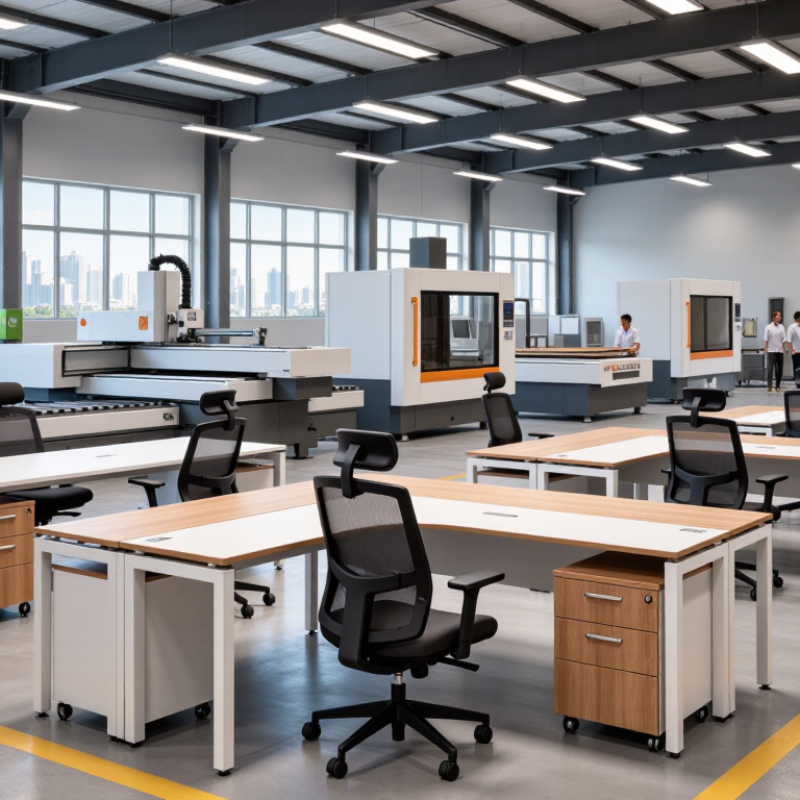
Capacity needs careful checking. A factory claiming 50,000 chairs monthly may include outsourced production. Ask for machine counts, assembly-line photos, warehouse space, and two months of delivery records. Lead time should be separated into sampling, production, inspection, and loading. In practice, stable factories may quote 25–45 days after approval, while customized projects often require longer. That is not always a weakness. Complex upholstery takes time. Rushed production can create uneven stitching and loose mechanisms.
Tips:
Request a live video audit, not only a PDF. Verify the ISO certificate through its issuing body. Ask for a BIFMA report matching the exact model. My ranking remains imperfect because factory data changes quickly. A spreadsheet can still lie. Small pilot orders reveal more than polished presentations.
Leading Chinese Manufacturers: Sunon, Lamex, Quama, and Onlead
China has become a strong source for office furniture, especially among four leading manufacturers with different strengths. One focuses on large-scale production and modern workplace systems. Another is known for international project experience and practical workstation design. A third offers refined executive furniture and coordinated interiors. The fourth emphasizes ergonomic seating, flexible layouts, and contemporary styling. Their product ranges often include desks, task chairs, storage units, meeting tables, and acoustic screens.
From supplier evaluations, I have learned that appearance is only one part of the decision. Check frame thickness, edge finishing, fabric durability, chair adjustment ranges, and replacement-part access. Ask for product samples and detailed specifications before placing a large order. Verify factory audits, testing documents, warranty terms, and delivery records. A showroom may look impressive. Daily comfort matters more. My first shortlist focused too heavily on design, which was a mistake. One attractive chair still felt uncomfortable after several hours of use.
Tips: Compare equivalent products, not only catalog photos. Request a video inspection of production and packaging. Confirm carton dimensions before shipping. Measure your room carefully, including doorways and lift access. Also, allow time for revisions. Small changes can affect cost, comfort, and delivery schedules. A supplier’s response to a difficult question often reveals more than polished marketing. Be willing to reconsider your choice. That step is easy to ignore.
Product Benchmarks: 275-lb BIFMA Loads, EN 1335, and Ergonomics
When evaluating office furniture manufacturers in China, test evidence matters more than polished showroom photos. A reliable supplier should provide traceable reports for a 275-pound BIFMA load benchmark, including test dates, product codes, and laboratory details. Inspectors should also check welds, caster movement, gas-lift stability, and fastener torque. Small details reveal manufacturing discipline.
EN 1335 compliance is another useful reference for office chairs. It addresses dimensions, safety, strength, and durability for workplace seating. Ask whether the tested model matches the production model. Substituting a thicker cushion or stronger base for testing can create a misleading result. It happens. Request drawings, material specifications, and random pre-shipment inspections. A certificate without traceability is weak evidence.
Ergonomics must work beyond a five-minute showroom trial. Seat height should let both feet rest flat, while adjustable lumbar support should meet the user’s lower back without pressure points. Armrests need enough range for relaxed shoulders. A stable recline mechanism can reduce fatigue during long screen sessions. However, “ergonomic” is not a universal guarantee. User height, desk design, and daily posture change the result. Serious manufacturers should support sample testing, adjustment feedback, and corrective action before mass production. That practical response often separates dependable factories from capable-looking ones.
Comparing MOQ, Customization, Warranty Terms, and Export Reach
For buyers comparing Chinese office furniture manufacturers, MOQ is often the first practical test. Industry sourcing data shows that standard desks and chairs usually support lower MOQs than fully customized products. A trial order may begin around 20–50 units, while private tooling can require several hundred. The figures vary by factory. That matters.
Customization should be measured beyond color selection.
Ask for approved drawings, material samples, load testing, and a production sample. The BIFMA market outlook continues to emphasize durability and ergonomic performance in commercial furniture. However, not every supplier follows the same testing depth. A factory may offer many finishes but limited engineering support. Confirm tolerances, replacement-part availability, and packaging protection before signing.
Warranty terms also need careful reading. Commercial furniture warranties commonly range from three to ten years, depending on the product category and usage conditions. Exclusions may cover fabric wear, improper installation, or unauthorized repairs. Export reach is another useful credibility signal. China Customs data reported furniture exports of about US$73.4 billion in 2023, although this figure covers broad furniture categories, not office products alone. A capable manufacturer should provide export references, carton specifications, and documents for your destination market. Data can look impressive. Factory-level proof is better.