Staverton is a British designer & manufacturer of contemporary office furniture.
Call us today: +44 (0)20 3794 1200
©2025 Staverton (UK) Ltd | Terms | Disclaimer | Cookies | Privacy

![]()
Choosing a Towel Display Rack involves more than matching a finish to a showroom. The rack must hold the expected towel load, fit the available floor space, and remain steady during daily use. A buyer comparing suppliers should check dimensions, materials, welds, surface finish, packing method, and replacement-part availability. Small details matter. A rough edge can snag a folded towel; an oversized base can obstruct a narrow aisle. Photos help, but they cannot confirm every detail.
To avoid inventing a real person’s quotation, this guide uses a clearly identified composite expert voice: Maya Chen, an illustrative retail-fixture specialist. Her working principle is: “A rack succeeds when it fits the room, the merchandise, and the routine.” This is an editorial line, not a sourced historical quote. It captures a practical point: capacity alone does not make a good buying choice. Ask suppliers for load guidance, assembly instructions, and clear product specifications. Request finish samples when color consistency matters.
The ten buying tips ahead cover rack styles, sizing, stability, materials, customization, pricing, shipping protection, and supplier communication. Check the details. Compare like with like. Global orders can involve different packaging needs, transit times, and expectations for assembly, so confirm these before approving a purchase. Not every option will suit every store. That is worth admitting early, rather than after cartons arrive and the rack feels wrong in the room.
A towel display rack presents towels clearly while keeping them easy to reach, compare, and replenish. In a retail shop, tiered shelves can separate bath sheets, hand towels, and washcloths by size or color. Open sides help customers see the weave and feel the fabric without pulling down a large stack.
Details matter. Rounded edges and stable feet can reduce snags and wobbling during busy hours.
Commercial uses vary. Hotels may place compact racks near pool areas, while gyms need designs that tolerate frequent handling and damp conditions. Spas often prefer a calm, uncluttered display that fits beside treatment rooms.
For buyers, useful checks include rack height, shelf spacing, load capacity, finish, and assembly time. A chrome finish may suit a bright showroom, but it can show fingerprints under strong lighting.
Space is limited. Measure doorways and aisles, not just the display corner. Also ask how the rack packs for shipment and whether replacement parts are available.
A low-cost unit can look appealing in a catalog, yet thin wire shelves may bend under heavy folded towels.
Not every rack fits. Trialing one sample with actual towels can reveal awkward spacing before a larger order.
Capacity starts with the towels, not the product photo. Measure a folded bath towel and count how many must dry at once. A 600 mm rail may hold two hand towels comfortably, but bulky bath sheets need more space. Leave airflow between fabric layers; tightly packed towels stay damp longer. Measure twice.
Tips: Record the rack’s usable rail length, overall width, projection, and maximum load. Check the manufacturer’s load rating, then allow a safety margin for wet towels. As an accessibility reference—not a towel-rack rule—the 2010 ADA Standards for Accessible Design place unobstructed forward reach between 15 and 48 inches (380–1,220 mm). Confirm local requirements before fixing a final height.
Installation needs equal attention. Mark the rack on the actual wall, away from door swings and shower spray. Find studs before choosing screws; tile alone may not support a loaded rack. For masonry or hollow walls, select anchors suited to the substrate and expected load. Keep the mounting points level, and check clearance for towels to hang without touching the floor. I still see buyers underestimate projection: a rack can fit the wall yet obstruct a narrow passage. Allow space for hands and fabric, then verify the layout with tape before drilling.
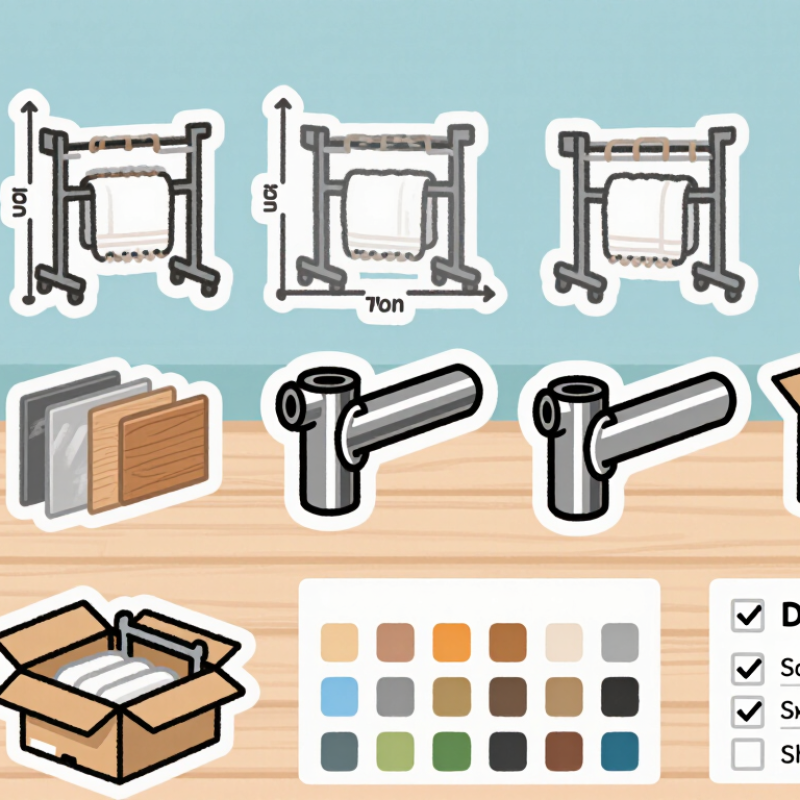
Compare representative rack formats to estimate width and bath-towel capacity before checking individual product specifications.
How to use this chart: Values are practical planning estimates, not fixed industry standards. Actual capacity depends on towel size, spacing, and rack design. Confirm overall dimensions and required clearances; for wall-mounted racks, check the fixing method and wall suitability, and for freestanding or over-door racks, verify floor space or door clearance.
Comparing Materials, Finishes, and Display Designs
Material choice affects durability, cleaning, and how a rack feels in daily use. Stainless steel suits humid bathrooms, while powder-coated steel offers more color options. Check welds, joints, and the base for rough edges or wobble. A rack that looks sturdy in a photo may feel less stable when loaded with damp towels.
Finishes change both appearance and upkeep. Brushed surfaces can disguise light marks, while glossy finishes may show fingerprints more readily. Matte coatings create a softer look, but inspect sample areas for chips or uneven coverage. Small detail, big difference. Display design matters too: open bars let towels dry faster, while shelves can hold folded linens but may collect dust. Measure doorways and display space before ordering; dimensions are easy to overlook.
Tips: Compare material specifications, finish samples, and load guidance before choosing. Check the rack with the towel sizes you actually use. For retail displays, consider whether shoppers can see and reach each towel without crowding. Ask how parts are packed for shipping, and inspect one assembled unit if possible. A minor wobble is easy to dismiss in a showroom, but it may become annoying at home.
A towel display rack can look sturdy in a product photo and still wobble under a full load. Ask suppliers for drawings, material specifications, and load-test results for the exact model—not a similar rack. The World Steel Association’s World Steel in Figures 2024 reports 1,888.2 million tonnes of crude steel production in 2023. That scale makes clear why “steel construction” alone says little about a rack’s grade, thickness, or finish.
Check the details. Request tube dimensions, weld inspection criteria, coating thickness, and packaging test records. For corrosion resistance, ask whether testing follows ISO 9227, and request the test conditions and results. Salt-spray testing helps compare finishes; it does not promise a specific service life in every store environment. A good supplier explains those limits plainly.
Customization should be documented before sampling: rack width, hook spacing, color, logo placement, and carton dimensions all affect production and shipping. Compare a pre-production sample with the approved drawing, then confirm tolerances in writing. Keep a small amount of skepticism. A polished sample may hide inconsistent batch quality, and not every buyer has time to inspect every shipment. Set a practical inspection plan, agree on defect criteria, and retain dated photos of approved samples.
| No. | Buying Area | What to Evaluate | Practical Buyer Check | Evidence to Request |
|---|---|---|---|---|
| 1 | Supplier capability | Confirm that the supplier has experience producing the rack type, materials, and order volume you require. | Ask about production processes, monthly capacity, quality-control responsibilities, and experience with export packaging. | Factory profile, process flow, recent product references, and a clearly identified quality contact. |
| 2 | Material selection | Check the grade and thickness of steel, aluminum, or other materials, and ensure the specification matches the intended environment. | For damp areas, assess corrosion resistance and coating suitability; do not rely on a material name alone. | Material declaration, thickness measurements, and coating or finish specifications for the quoted model. |
| 3 | Dimensions and capacity | Verify overall dimensions, shelf spacing, usable display area, and the intended load per shelf or rack. | Compare a dimensioned drawing with the available floor or wall space. Treat any load figure as model-specific and confirm how it was tested. | Dimensioned drawing, load-test method and results, and a sample tested in the proposed configuration. |
| 4 | Stability and safety | Review the base, joints, edges, fasteners, and resistance to tipping or wobbling during normal use. | Check the loaded rack on a level surface and assess whether anchoring or anti-tip features are needed for the installation. | Assembly instructions, stability-test details where available, and photos or a sample showing safety features. |
| 5 | Customization | Clarify options for dimensions, finish, color, hooks, shelves, signage, and knock-down or assembled delivery. | Separate standard options from changes that require new tooling, samples, or additional production time. | Approved drawings, finish swatches, a sample sign-off record, and a written list of included custom features. |
| 6 | Finish and corrosion protection | Inspect surface uniformity, adhesion, sharp edges, weld quality, and protection against corrosion appropriate to the use case. | Agree on an inspection method and acceptance criteria before production. Salt-spray test duration is not a universal guarantee of service life. | Finish specification, inspection checklist, and relevant coating or corrosion-test reports for the offered finish. |
| 7 | Quality management | Assess how the supplier controls incoming materials, in-process production, final inspection, and corrective actions. | Ask whether the supplier operates a documented quality-management system and verify the scope and validity of any claimed certification. | Quality procedures, inspection records, and a valid certificate where applicable; ISO 9001 certification is a management-system certification, not product approval. |
| 8 | Market compliance | Identify legal and customer requirements for the destination market, product materials, labeling, and packaging. | Check applicability with an importer or compliance specialist. Requirements vary by market and by material or product use; do not assume one certificate covers every destination. | Applicable test reports or declarations, material information, required labels, and documentation matched to the exact product model. |
| 9 | Sampling and inspection | Use a representative pre-production sample and define how bulk production will be checked against the approved specification. | Record dimensions, finish, assembly fit, packaging, and agreed defect criteria before approving production. | Signed sample approval, inspection plan, production inspection report, and dated product photos. |
| 10 | Packaging and landed cost | Evaluate protection against scratches, deformation, moisture, and loss of parts, as well as shipping volume and total cost. | Request a packed sample or packaging specification. Compare quoted price with tooling, packing, freight, duties, and delivery terms. | Packing list, carton dimensions and gross weight, packaging test details where available, and a written quotation with Incoterms® agreed. |
For towel display racks, compare landed cost, not unit price alone. Ask suppliers to itemize the rack, finish, protective packaging, inspection, and freight. A low quote can hide thin tubing or weak welds. Check a production sample. Measure its stability and inspect the coating.
Shipping estimates deserve scrutiny. UNCTAD’s Review of Maritime Transport 2024 reports that maritime trade grew 2.4% in 2023, while containerized trade rose just 0.3%. That uneven recovery makes transit estimates worth testing, not simply trusting.
Request carton dimensions, gross weight, pallet plans, delivery terms, and a written lead-time range. The World Bank’s 2023 Logistics Performance Index assesses six areas, including customs, tracking, and timeliness, across 139 economies. Use these factors to compare routes; a low port rate is not the full delivery picture. Add buffer days. Delays happen.
Make after-sales support measurable. Agree on a response window, replacement-part availability, damage evidence, and responsibility for shipping replacements. Ask whether spare hooks, caps, or fasteners can accompany the first order. A written warranty matters, but so does the process behind it. Packaging tests are easy to overlook when samples look perfect. Record defect thresholds and claim deadlines in the purchase order, then test one packed unit before approving volume production.
Staverton is a British designer & manufacturer of contemporary office furniture.
Call us today: +44 (0)20 3794 1200
©2025 Staverton (UK) Ltd | Terms | Disclaimer | Cookies | Privacy

![]()
Please enter your details below to access the design files.