China Best Fluted Coupe Glasses Manufacturer?
Choosing a China-based Fluted Coupe Glasses manufacturer takes more than comparing catalog photos. Buyers need to assess glass clarity, rim finish, pattern consistency, packaging, and the supplier’s ability to repeat a sample at scale. One coupe may look elegant under studio lights; a shipment of 2,000 can reveal uneven flutes or cloudy edges. Small details matter.
Grand View Research’s Glassware Market report estimated the global glassware market at about US$8.3 billion in 2023. That figure covers glassware broadly, not fluted coupe glasses alone, so it should not be treated as a category-specific forecast. Still, it signals a substantial market where product differentiation and dependable manufacturing can influence purchasing decisions. Charles Eames, an influential product designer, put the role of detail plainly: “The details are not the details. They make the design.” For buyers, that idea applies to the coupe’s pressed or molded pattern, its balance in the hand, and the smoothness of its rim.
A useful supplier review should request current production photos, sample specifications, packaging details, and clear information about quality checks. Ask how the factory controls dimensions and surface defects across repeat orders. Then test the sample yourself. Hold it by the stem. Check how it sits on a table. There is no perfect supplier, and a polished website is not proof of consistent output. This guide examines what buyers can verify when comparing China’s Fluted Coupe Glasses manufacturers, while separating measurable capabilities from attractive claims.
What Defines a Fluted Coupe Glass and Its Distinctive Design?
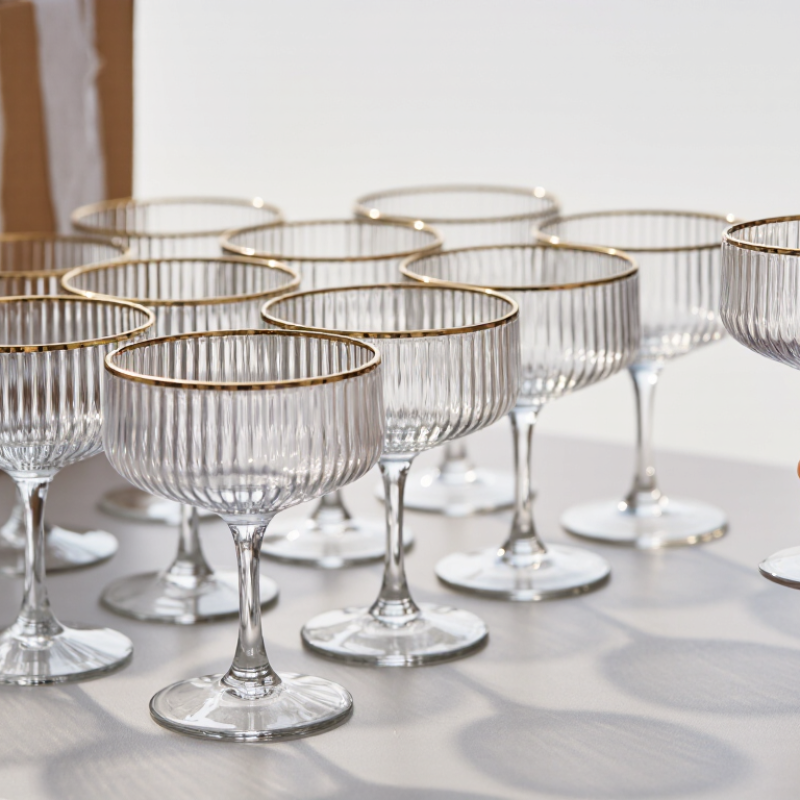
A fluted coupe glass has a broad, shallow bowl, a short stem, and vertical ridges that run along the glass. Those grooves catch light in narrow bands, giving the surface more depth than a smooth coupe. The shape feels balanced in the hand, though the wide rim can make the glass seem delicate. Fluting describes the ribbed design, not a fixed size or a particular way of making the glass.
The ridges may be pressed into the glass or formed through cutting, so their spacing and finish can vary. Closely spaced flutes create a fine, bright pattern; deeper grooves make a bolder silhouette. They can also provide a little extra grip, but they do not make the glass unbreakable. In use, the shallow bowl offers an open view of a drink’s color and surface. It also means spills may happen more easily if the glass is filled too high. That trade-off is easy to overlook.
Tips: Check that the stem feels steady and the rim is smooth. Wash the grooves gently, since residue can collect between them. A small detail, but worth checking. Don’t judge fluting by photographs alone; lighting can exaggerate the ridges, and the real texture may feel subtler.
How Are Fluted Coupe Glasses Manufactured in China?
Fluted coupe glasses made in China typically begin with a batch of silica sand, soda ash, limestone, and carefully sorted recycled glass. The batch melts in a furnace; Glass Alliance Europe reports that glassmaking temperatures can reach about 1,500°C. A measured gob of molten glass is then pressed or blown into a mold. Its inner ribs create the fluted pattern. The bowl and stem may be formed separately and joined while hot, or produced through a more automated process, depending on the factory and order.
After forming, each glass passes through an annealing lehr, where controlled cooling reduces internal stress. FEVE’s 2023 industry report estimates that adding 10% cullet to a glass batch can reduce furnace energy use by about 2.5%; actual savings depend on the glass recipe and furnace. The rim is checked for chips, and samples are inspected for dimensions, clarity, weight, and flute consistency. Small variations can still appear between production runs. That is worth checking, not glossing over. Buyers should request samples and confirm packaging tests, because a well-made bowl can still arrive damaged if its carton allows the stems to knock together.
Which Materials and Quality Standards Matter Most?
Material choice affects clarity, weight, and daily durability. Soda-lime glass is common and can suit frequent service when the forming and annealing are well controlled. Lead-free crystal may offer greater brilliance, but its composition and food-contact suitability should be documented. A clear bowl is not proof of safe or consistent materials. Ask the manufacturer for material specifications and relevant test reports.
Quality shows up in small details. The flutes should feel even, without sharp ridges or cloudy patches. Check that the rim is smooth and the stem meets the bowl cleanly. The coupe should sit level on a flat surface. Small flaws matter. They can weaken the glass or make a set look inconsistent. I would compare several pieces from one production run, not just approve a polished sample.
Useful checks include dimensional consistency, visual inspection, and testing suited to the intended use, such as dishwasher durability when that claim is made. Confirm that testing comes from a qualified laboratory and applies to the finished glass, not merely its raw material. Ask which food-contact requirements and quality standards apply in the destination market. One imperfect point: tolerances can vary by production method, so buyers should agree on acceptable limits before ordering.
China’s Fluted Coupe Glasses: Which Materials and Quality Standards Matter Most?
Typical linear thermal expansion coefficients for selected glass types. Lower values generally indicate better resistance to temperature change, but formulation and manufacturing also affect performance.
What to check: Soda-lime glass is widely used for tableware; borosilicate glass expands less and is more resistant to thermal shock. Values are typical and can vary by formulation. For coupe glasses, also assess annealing, rim finish, consistency, and compliance with applicable food-contact requirements.
How to Evaluate China’s Fluted Coupe Glass Manufacturers
China Best Fluted Coupe Glasses Manufacturer?
How to Evaluate China’s Fluted Coupe Glass Manufacturers
Choosing a manufacturer takes more than comparing product photos and prices. Examine a physical sample under natural light. Look for even fluting, a level foot, a smooth rim, and clear glass without visible bubbles or scratches. Small differences matter. They affect both the look and feel of a finished drink.
Ask how the factory controls mold consistency and annealing, the process that helps reduce internal stress in glass. Request measurements for bowl diameter, height, capacity, and weight. Then compare several pieces from the same sample set. A single flawless glass proves little. The production batch is what matters. Ask for quality inspection records and packaging details, including how each glass is protected during shipping.
Communication deserves a close look, too. Can the supplier explain sample timelines, order quantities, and what happens when production varies from the approved sample? Specific answers are more useful than broad promises. If a particular safety or quality standard matters to your market, request relevant documentation and verify its scope. A polished sample can create confidence, but it is not proof of consistent output. Even careful checks have limits, and that is worth admitting before placing a large order.
What Customization and Order Factors Should Buyers Compare?
When comparing a fluted coupe glass manufacturer, ask for the same specifications from every supplier. Confirm capacity, overall height, rim diameter, stem shape, and flute depth. Small changes affect how the glass feels in the hand and how consistently it stacks. Request a finished sample, not only a drawing. Check it with a drink inside. Does the rim feel comfortable? Does the bowl look balanced?
Customization can include glass color, engraved marks, surface finish, and gift packaging. Ask whether these options require a new mold or add setup charges. Clarify the acceptable variation in dimensions and finish, then put it in writing. A sample can look perfect under showroom lights. That proves little about a full production run. I would compare production samples when possible.
Order terms matter just as much. Compare minimum order quantity, sample fees, production time, payment stages, and replacement policies for transit damage. Ask how each glass is packed; dividers and snug inner cartons can reduce clinking and breakage. Request carton dimensions and gross weight before arranging freight. Get the inspection method and defect criteria in writing. Some details still get missed. Recheck them before approval. A lower unit price may not be lower after packaging, rejects, and shipping are included.